
Songwriting Guide
If you ever made up a song as a kid, you’ve already written one. Our songwriting resources help your students do it on purpose.
A three-level guide to songwriting with your students, from lyric templates and chord progressions to helping them find their own voice.
Intuitive Songwriting
If you ever made up a song as a kid, you’ve already written one. Our songwriting resources help your students do it on purpose.
Going from a blank page to a finished song can feel like a magic trick. It isn’t. Songs follow patterns, and once students know a few of them, they can write something that sounds like a real song on their first try.
Here’s what we believe: everyone can write songs, songwriting is learned through songwriting, and the best way to develop your own creative voice is to make lots of music.
We’ve broken things into three levels. You don’t have to go in order. Think of them as different places to jump in, depending on how much structure or creative freedom your students need. As they gain experience, they’ll naturally start making more of their own choices.
Level One: Write Some Lyrics
The first step is writing some lyrics. Lyrics naturally imply rhythm through the patterns of speech and can even suggest melodic possibilities. For many beginning songwriters, finding a melody that fits existing lyrics is easier than trying to fit new lyrics to an existing melody.
To make this easy, we have lyric-writing templates. These simple formulas are reverse-engineered from popular songs. As it turns out, many of these songs follow similar patterns that allow us to quickly make a song that, well, sounds like a song.
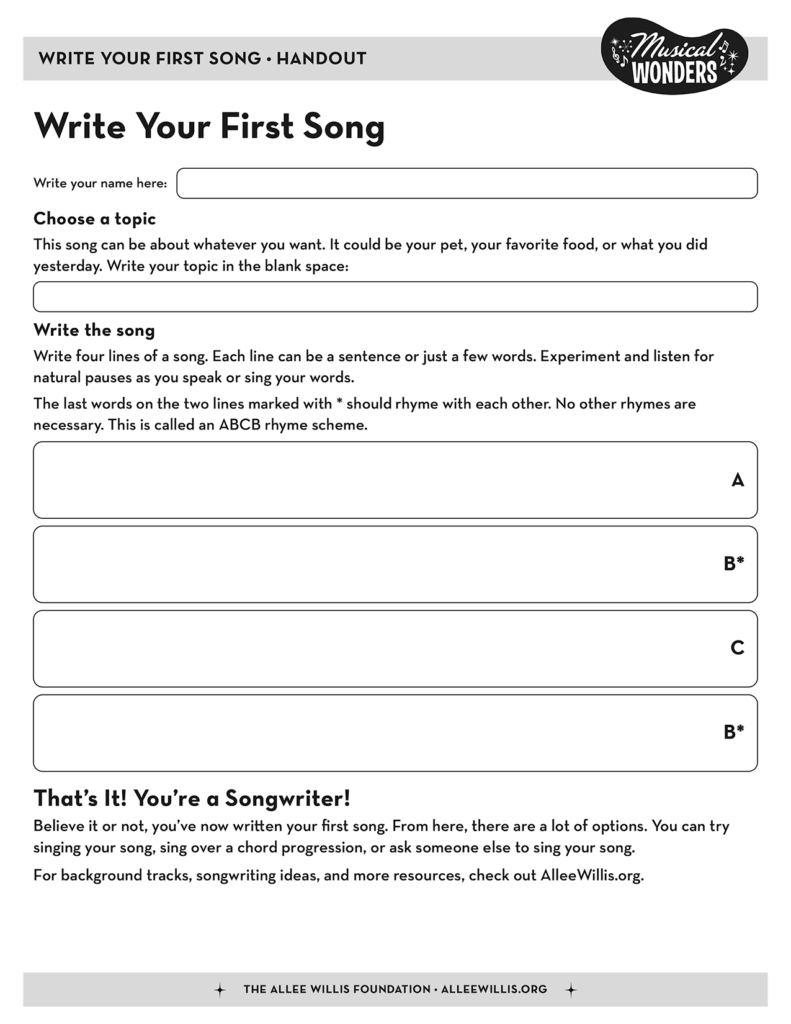
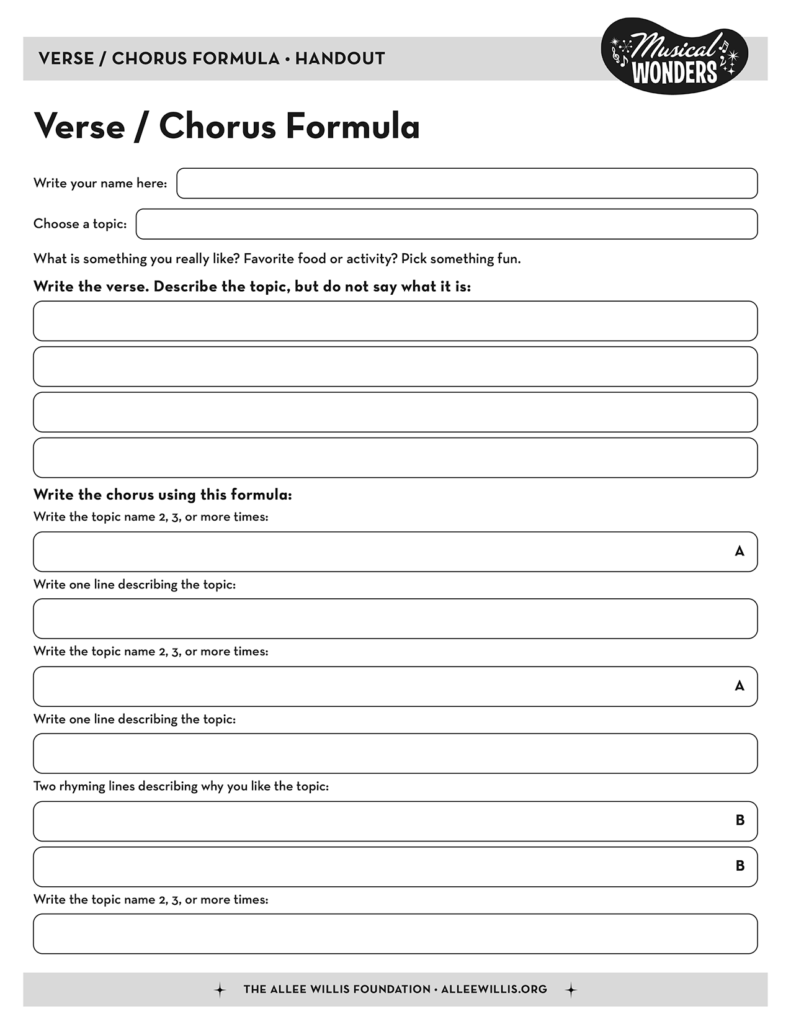
Our templates start simple with Write Your First Song and Verse/Chorus Formula and go through various kinds of song forms like Write a Cartoon Theme Song, Commercial Jingles, and List Songs. Some templates are very specific, recommending the rhymes, number of lines, and topics. Other templates are more open-ended and focused on form, leaving the number of lines and rhymes up to the songwriter.
Parody Songwriting
Another way to get into writing lyrics is to write “Weird Al” style parodies. You take an existing song and write new lyrics. You can even perform your song using a karaoke track of the original. This is great practice because you will need to imitate the rhyme scheme, the number of lines, and even the syllables.
We also encourage you to listen to lots of music! Pay attention to how your favorite songwriters use repetition, rhyme, verses, choruses, and other songwriting techniques. The more music you listen to, the more possibilities you’ll discover in your own writing.
Level Two: Setting Lyrics to Music
When it comes to turning lyrics into a song, there are a couple of approaches we encourage.
- Just sing the lyrics a cappella.
- Sing the lyrics over a common chord progression.
Neither approach requires extensive musical training, and you don’t need instruments, notation, or recording software to write a complete song.
Singing the Lyrics
Almost every child makes up songs. Young children frequently invent melodies and sing spontaneously as part of their everyday play. This is songwriting!
It’s okay to just sing the lyrics and make up a melody. In fact, this might be the easiest, most natural way to set your lyrics to music.
Experiment and iterate until you have something you like, then record it. A simple recording on your phone is plenty. You don’t need a fancy studio or even instrumental accompaniment.
Don’t worry about getting everything right the first time. Try different rhythms, change a few notes, and see what happens. Sometimes the best ideas come from experimenting without worrying about the final product.
Common Chord Progressions
Many songwriters select harmony first and then weave their melody through a chord progression. This is a very common approach to songwriting, especially for singer-songwriters.
To make this easy, we have a list of common chord progressions that we recommend. Countless popular songs use these same progressions, so we encourage you to write a few hundred yourself! If you experiment with these progressions enough, you’ll start having opinions about your preferences and gain enough harmonic experience to explore more.
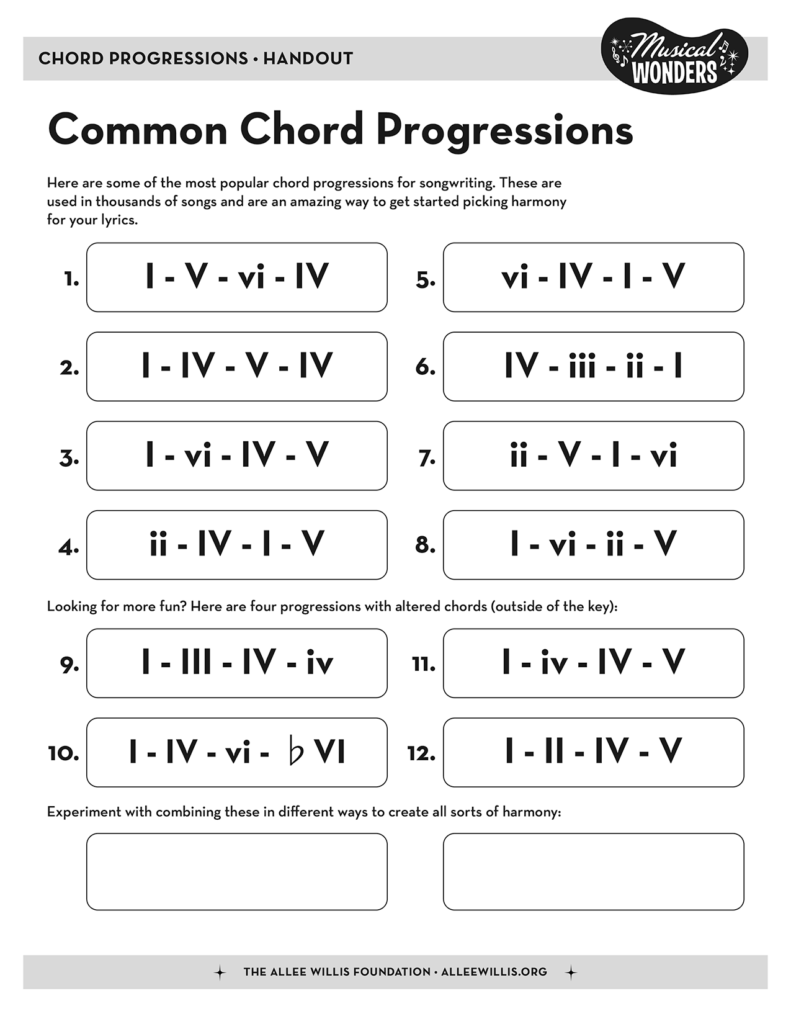
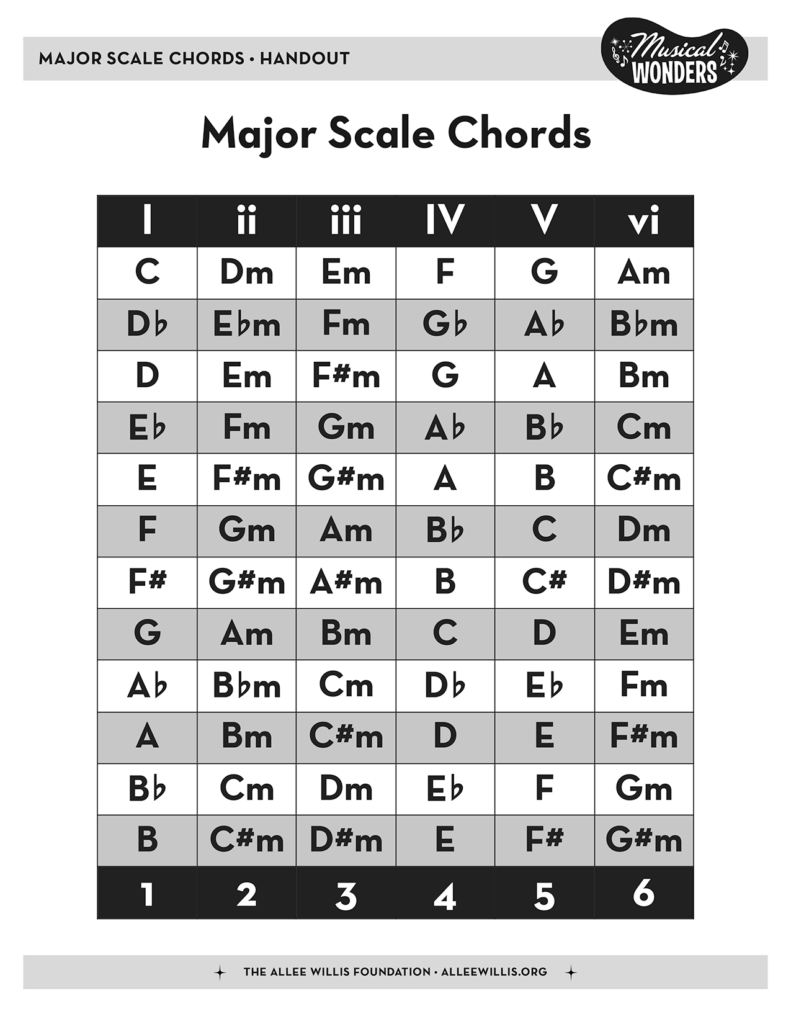
If you play guitar, piano, ukulele, or another chordal instrument, you can just play these chords and sing over them. You could also have another person who plays one of these instruments play while you sing, or vice versa. We even have handouts for all of the chord progressions for these instruments.
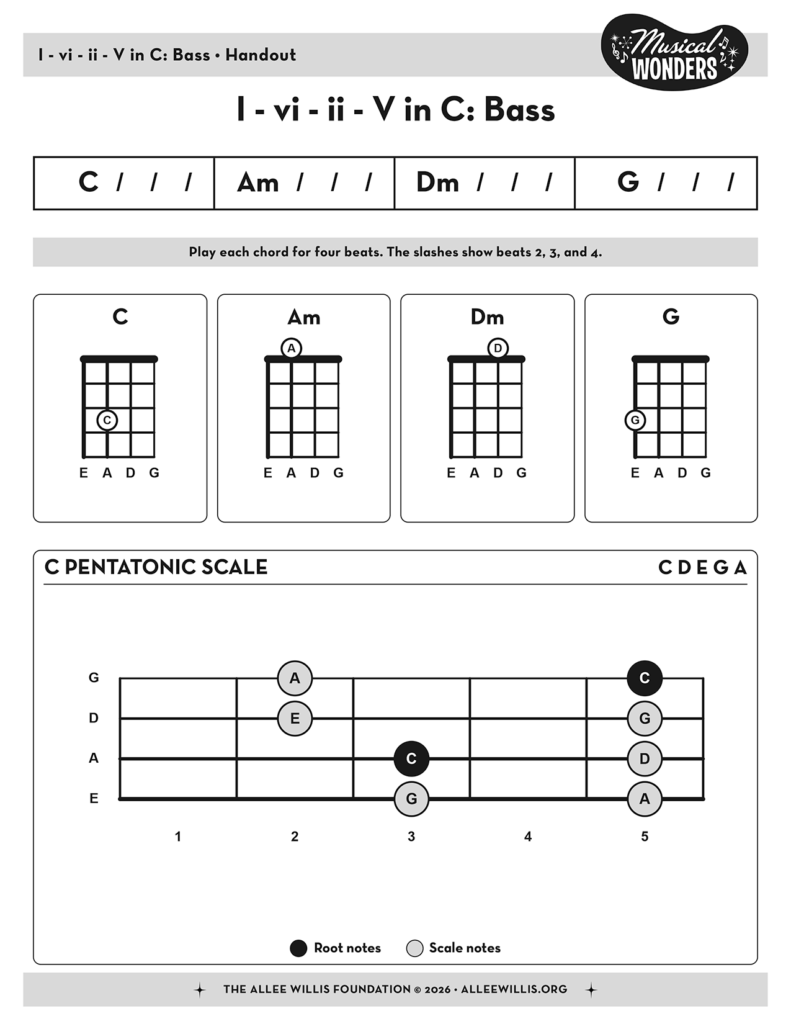
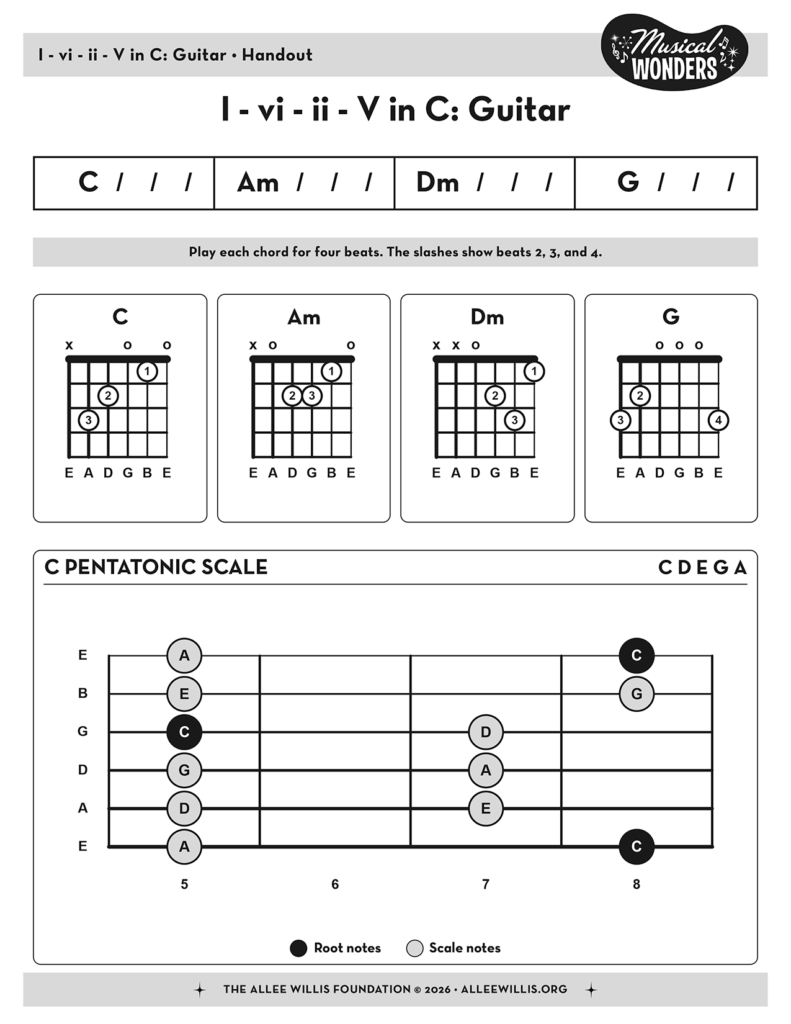
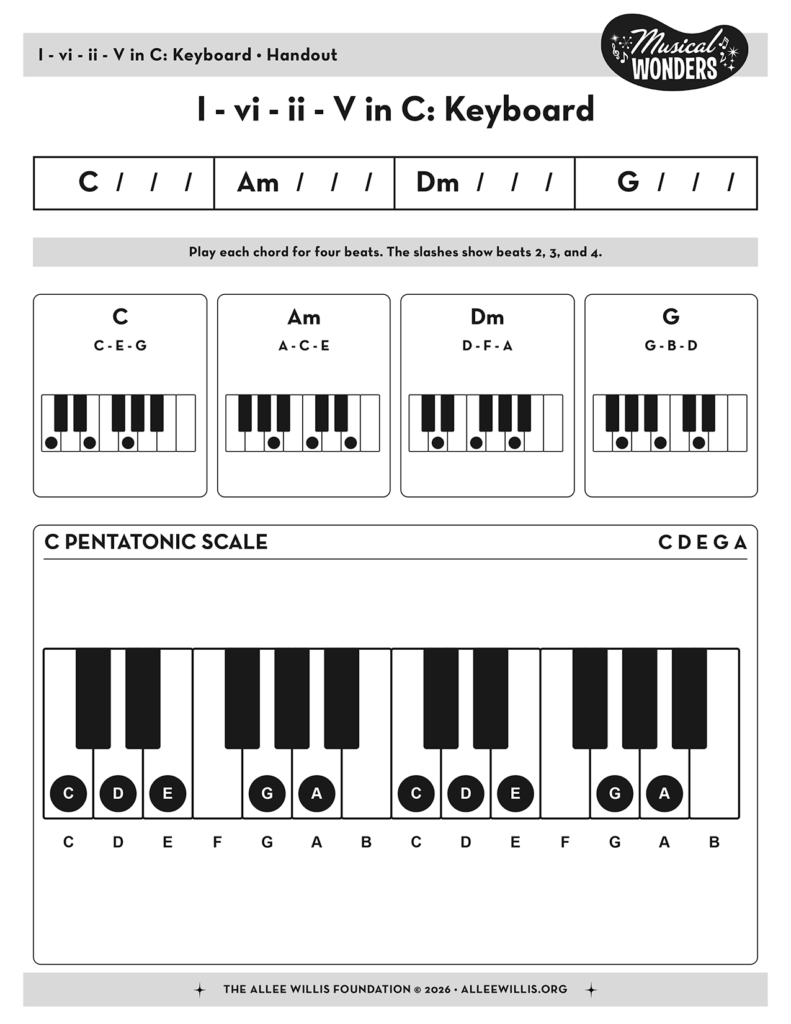
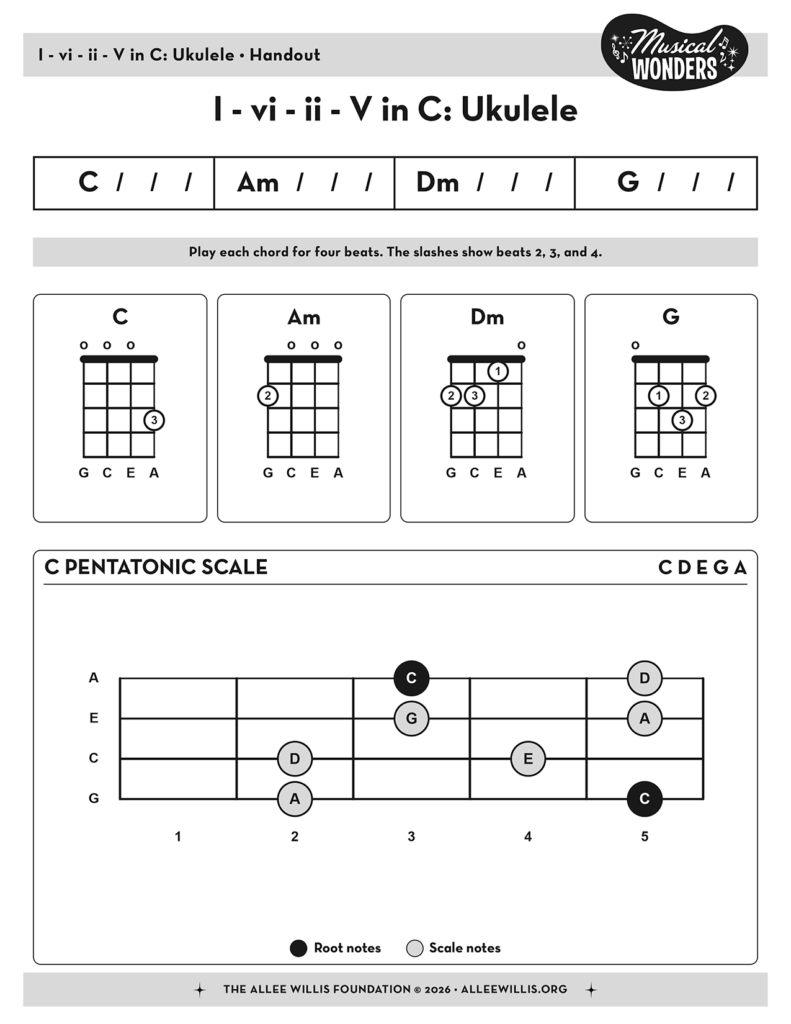
Another option is to realize your chord progression in software like SessionBand, GarageBand, Band-in-a-Box, or another digital audio workstation (DAW).
Finally, we also have background tracks for each of these progressions that you are welcome to use to try out your lyrics.
This is also a great opportunity for collaborative songwriting. One person might write lyrics, another might suggest melodies, and someone else might play chords. You don’t have to do everything yourself, and making music with other people is one of the best ways to learn.
Remember, the goal isn’t to write one perfect song. It’s to write lots of songs, experiment with different sounds, and gradually discover what you like.
Level Three: Make It Your Own
After you’ve written a few songs, you’ll probably start to have opinions about the kinds of songs you like to write, preferred chord progressions, and more. At this point, you’re going to want to mix things up.
This is a great place to start experimenting with more forms, mixing up the chords, and seeing what happens.
Expand your techniques through experimentation, collaboration, and imitation. Find ways to mix up your writing. Do you always start with lyrics? Try starting with harmony. Try writing over just a drum track. Start with a melody and find lyrics that fit. Work with a friend who approaches songwriting differently than you do.
Constrain yourself (or your students) to open up new songwriting possibilities. Try writing a song with only two chords, using just four lines of lyrics, or limiting yourself to a particular topic. Sometimes having fewer choices makes it easier to be creative.
You can also start breaking the formulas you’ve learned. Our songwriting templates and chord progressions are tools, not rules. They’re designed to help you get started, not to limit what you can create.
The more experience you gain, the more you’ll begin developing your own songwriting process. You may discover that you prefer starting with lyrics, harmony, melody, rhythm, or some combination of all four. There’s no single correct way to write a song.
Most importantly, write a lot.
The best songwriters write lots of songs. For every hit song, there are often countless others that never get released. But those songs aren’t wasted. Every song is an opportunity to experiment, develop your musical instincts, and discover new possibilities.
Don’t feel like every song needs to be a masterpiece. Some songs might take five minutes, others might take five months. Some will be worth revisiting, and others might just be fun to write.
The goal isn’t to become better at following songwriting formulas. It’s to become a songwriter who no longer needs them.
The more music you make, the more confident you’ll become in your own creative choices. And that’s what Musical Wonders is all about.
Musical Wonders is the flagship program of The Allee Willis Foundation, offering free workshops and online resources that help music teachers bring songwriting and creative music-making into their classrooms.